Home › Is Social Security Taxable?

Guide toForm SSA-1099

Is Social Security Taxable in 2026?

Short answer: it depends on your other income. There is no full “no tax on Social Security” law — but the new $6,000 senior deduction means many retirees will owe little or nothing on their benefits for 2025–2028.

2026

Checked against IRS Publication 915, Social Security and Equivalent Railroad Retirement Benefits and 2 more official sources on November 21, 2026. How we check

The provisional income test

To see how much of your benefit is taxable, add up your provisional income:

Provisional income = adjusted gross income (without Social Security) + tax-exempt interest + half of your Social Security benefits

Provisional income — single / HOHProvisional income — married filing jointlyPortion of benefits that can be taxed
Under $25,000Under $32,0000%
$25,000 – $34,000$32,000 – $44,000Up to 50%
Over $34,000Over $44,000Up to 85%

These thresholds are written into the law and have never been adjusted for inflation, so more retirees cross them every year. Married people filing separately who lived together during the year generally have up to 85% taxable from the first dollar.

“Up to 85% taxable” doesn’t mean an 85% tax — it means up to 85% of the benefit is added to taxable income, which is then taxed at your normal bracket.
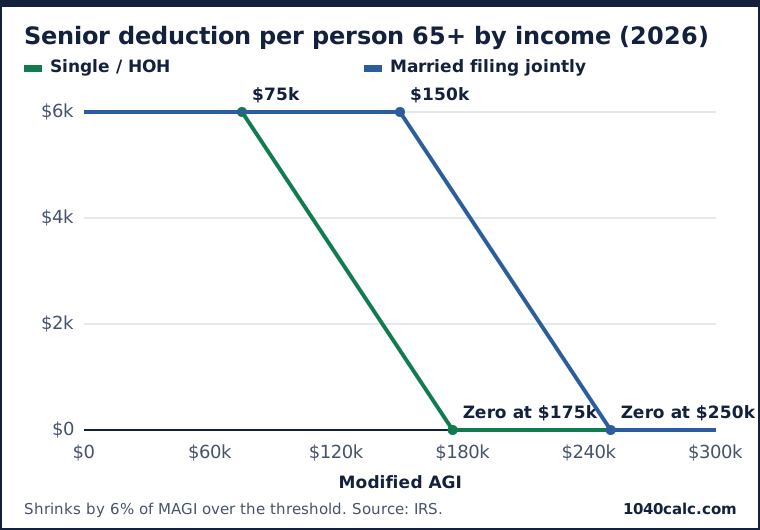
Line chart of the senior deduction per person by income
Senior deduction per person 65+ by income (2026)

Is there “no tax on Social Security” now?

Not exactly. The 2025 law did not exempt benefits from tax. Instead it added a temporary $6,000 deduction for each person 65 or older (2025–2028), which phases out above $75,000 of modified AGI ($150,000 joint). For many middle-income retirees, that deduction is large enough to cancel the tax on their benefits.

Worked examples (tax year 2026)

Single, 68, $24,000 Social Security + $20,000 IRA withdrawals. Provisional income = $20,000 + $12,000 = $32,000 → between $25,000 and $34,000, so taxable benefits = 50% × ($32,000 − $25,000) = $3,500. AGI = $23,500. Deductions: $16,100 standard + $2,050 age 65 + $6,000 senior = $24,150 → taxable income $0. No federal tax.
Married, both 70, $48,000 Social Security + $60,000 pension. Provisional income = $60,000 + $24,000 = $84,000 → over $44,000. Taxable benefits = 85% × ($84,000 − $44,000) + $6,000 = $40,000 (less than the 85% cap of $40,800). AGI = $100,000. Deductions: $32,200 + $3,300 + $12,000 = $47,500 → taxable income $52,500; tax ≈ $5,804. Without the senior deduction it would be about $7,244.
Single, 66, $30,000 Social Security only. Provisional income = $15,000 → under $25,000, so none of the benefit is taxable.

Lowering the tax on your benefits

Most states don’t tax Social Security; a handful still do for higher-income residents.

Frequently asked questions

Is Social Security taxable in 2026?

Up to 50% or 85% of benefits can be taxable if provisional income exceeds $25,000 single or $32,000 married filing jointly. Below that, benefits are tax-free.

Did the 2025 tax law eliminate tax on Social Security?

No. It added a $6,000-per-person senior deduction for 2025–2028 that reduces or eliminates the tax for many retirees, but benefits can still be taxable.

What counts in provisional income?

Your AGI without Social Security, plus tax-exempt interest, plus half of your Social Security benefits.

Can I have tax withheld from Social Security?

Yes. File Form W-4V to have 7%, 10%, 12% or 22% withheld.

Sources

Last updated: . Figures reflect IRS, SSA and CMS guidance published as of this date.