2026 long-term capital gains brackets
The rate depends on your total taxable income, including the gain.
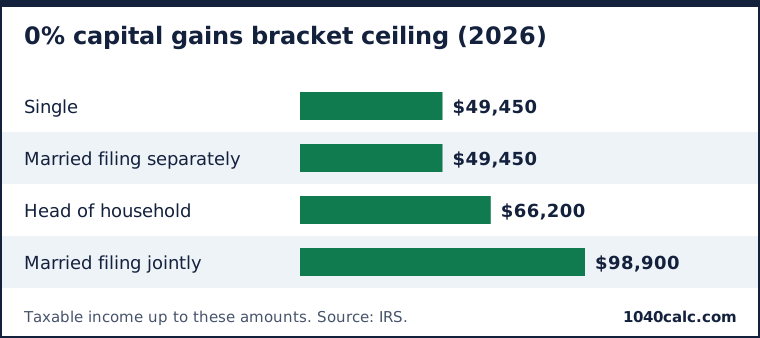
| Filing status | 0% rate | 15% rate | 20% rate |
|---|---|---|---|
| Single | Up to $49,450 | $49,451 – $545,500 | Over $545,500 |
| Married filing jointly | Up to $98,900 | $98,901 – $613,700 | Over $613,700 |
| Head of household | Up to $66,200 | $66,201 – $579,600 | Over $579,600 |
| Married filing separately | Up to $49,450 | $49,451 – $306,850 | Over $306,850 |
Qualified dividends use the same brackets.
Short-term vs. long-term
| Held one year or less | Held more than one year | |
|---|---|---|
| Name | Short-term gain | Long-term gain |
| Rate | Ordinary income rates (10%–37%) | 0%, 15% or 20% |
Collectibles (art, coins, precious metals) are taxed at up to 28%, and the depreciation part of a rental property sale (“unrecaptured section 1250 gain”) at up to 25%.
The 3.8% net investment income tax
On top of the rates above, a 3.8% tax applies to investment income to the extent modified AGI exceeds $200,000 single or $250,000 married filing jointly ($125,000 married filing separately). These thresholds are fixed in law and don’t rise with inflation.
How the brackets stack — worked examples
Married couple, $80,000 of wages, $40,000 long-term gain. Taxable income before the gain = $80,000 − $32,200 = $47,800. The 0% bracket runs to $98,900, so the first $51,100 of gains would be tax-free — the whole $40,000 gain is taxed at 0%.
Single, $60,000 salary, $30,000 gain. Ordinary taxable income = $60,000 − $16,100 = $43,900. Only $5,550 of room is left in the 0% bracket ($49,450 − $43,900). Tax on the gain = $0 on $5,550 + 15% × $24,450 = $3,668.
Retired couple, both 66, “harvesting” gains. With $60,000 of IRA and pension income, taxable ordinary income is $60,000 − $32,200 standard − $3,300 age‑65 add‑ons − $12,000 senior deduction = $12,500. That leaves about $86,400 of gains they could realize at 0% in 2026 (their modified AGI stays under $150,000, so the senior deduction isn’t reduced). Watch Medicare IRMAA thresholds, which count the full gain.
Ways to lower capital gains tax
- Hold assets more than a year before selling.
- Harvest losses to offset gains; up to $3,000 of net losses can offset ordinary income each year.
- Realize gains in low-income years to use the 0% bracket.
- Exclude up to $250,000 ($500,000 joint) of gain on a main home you’ve owned and lived in for 2 of the last 5 years.
- Give appreciated stock to charity instead of cash.